Food Photography Basics - Aperture, F-Stops & DOF
Before you run away after reading the title, repeat with me - "aperture is my friend". If you haven't met yet, then now is the best time!
So, meet your best friend when it comes to food photography - aperture!
Before we go on to learn more about aperture, let's quickly recap what I shared in the introduction post.
- Light is the most important component in any kind of photography.Ok, now its time to meet aperture.
- If you determine where to place your food and how much light there should be, you are that much closer to clicking great pictures.
- Click lots of pictures in different angles and even in different light situations (near window, facing window, on kitchen counter, even under a table lamp) to find out which one works best for you and your camera and even your dish.
Your lens camera is like your own eyes. Of course, with technology and digital cameras, the clarity and range is superior to human eyes but the basic concept of how they work is the same.
To understand this further, and yes I did this, hold your thumb about 15cm from your eyes and focus on it. You will notice that the thumb is clear whereas the background is blurred.
Now, try holding your thumb in the same position and look at an object in the background without having to move your head. You will notice that your thumb is blurred. Right?
This is the exact concept behind using aperture settings for your food photography. The idea is to focus on one object or one part of the object and the background will appear blurred. Now, the amount of blur or clarity of focus depends on your camera and how much of it you can manually set.
With my old basic Nikon L10, there were hardly any settings I could control. So all I used to do was turn on the macro setting and shoot away. This is where lighting becomes even more important. The more basic the camera, the more preparation you will need to do with respect to lighting, angle of shot and editing afterwards. In the next post, I will share one quick trick in photoshop that will help you blur the background 'cuz our friend, aperture, is waiting to meet you.
So, more about aperture now.
Aperture is what controls the entry of light into your camera lens, like the pupils in our eyes. The larger the aperture setting, the more light you are allowing into your camera lens, and vice versa.
A confusing bit here, and this took me about 8 months (ok, 2 years) to digest, is that the larger the aperture setting number (called F-Stops) in your camera, the smaller the opening that lets light in, and vice versa (let me know when this expression starts getting annoying!)
Once more - the larger the F-Stops, the lesser the amount of light entering your camera lens. The setting is denoted by an 'f' in most cameras.
The range for my camera is from f2.8 to f8. So -
f 2.8 means a bigger opening and more light can enter the lens.
f 8 is the smallest opening and less light can enter the lens.
This brings us to the next character that we need to meet, Depth-of-Field (DOF). No no, I am not going to kill you now with information overload. I just want you to know what DOF means as well, since F-Stops and DOF are very closely connected.
Ready?
Ok.
Depth of Field means how much of the photo is in focus and how much is blurry. If you can choose these settings in your camera, then you are already well on your way to taking much better looking pictures.
So a shallow depth of field means the subject will be in focus, the background will be blurred and you will need to choose a large aperture, which would be a small number, like f 2.8.
This technique is very useful for food photography and for taking portraits.
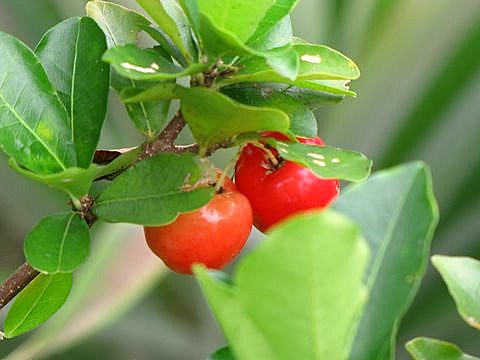
This pic was taken with f3.2. I wanted to focus on the branch that had the fruits (acerolas) and blur the rest.
A large depth of field means you want pretty much the entire picture in focus and so need a small aperture which would be a large number, like f 8.
For SLR cameras, the F-Stop ranges may be around f1.4 to f22 which explains some wonderfully background-blurred pictures in some food blogs that you have admired.
This pic was taken with f8. You will see that I wasn't trying to focus onany one thing (no hot guys on the beach that day), just the landscape.
If you are wondering why I started off all simple and then went technical on you, fret not! Next week, I will share some editing options for basic point and shoot cameras. No jargons, I promise!
If you liked this post and would like to show me some love for the 8 hours I spent on writing it, please stumble the post by clicking the button below.



Wow Nags, you have complete gyaan on this - thanks so much for sharing it !! Lovely pics and great tutorial for Photography Dummies like me. And thanks for the tips you gave to my previous comment - Cant thank you enough !!
ReplyDeleteNags,wonderful that you love to share all these..your interest and pictures are simply amazing.
ReplyDeleteArch - Anytime! Just email me or buzz me here if you need any further thoughts or help :)
ReplyDeleteAnn - thanks a ton Babes! Encouragement always helps :)
I must say that this is the simplest way you have explained to understand aperture!! cool! I think who ever can catchup with this can give better pictures in their blogs here after!
ReplyDeleteWhere u caught that durian pic?
LOL at ur beach picture,TH not reading ur posts?!!
And waiting for more :)
Raks - Thanks a lot, does it show I was a trainer before I took on my current role? :D
ReplyDeleteThe durian picture is from a tropical fruit farm in Penang, Malaysia. We went there for the new year break. The acerola pic is also from there. That fruit was quite intriguing. It originated from Texas but is grown more in Mexico. The farm owner brought back some seeds and started growing them in Malaysia. We were served a pineapple-acerola juice there and that is the best juice I have ever had in my life!
No, TH doesn't visit this site much and definitely doesn't read through each post. He has subscribed via email though ;)
You have some wonderful insight here for newbies and pros.....I really appreciate you sharing your knowledge with everyone!
ReplyDeletecheers, trupti
the spice who loved me
Nags, whether you used jargons or not, you have explained it in a very light and interesting way.... as you got my attention right from beginning to end, which is usually very difficult in my case :P
ReplyDeleteall the best with your new series.....
Thats a nice and detailed post...great going Nags..
ReplyDeleteVery informative post,would surely keep this in mind the next time when i am clicking
ReplyDeleteKeep the info pouring it,we are thoroughly enjoying these and learning at same time
Nags, you are doing a great job by demystifying photography. Thank you and keep it up
ReplyDeleteWOw nags..really really useful for beginners like me.Will keep the tips in mind..Awesome pics..U made me understand the aperture..thanx a lot...keep going..great post:)
ReplyDeleteNags.. very informative post... helpful for people like me who always end up taking bad pics :( ... will use these concepts and try :)
ReplyDeleteHey...I was waiting for this post. it was really helpful and full of tips. I will knock at ur door when I have any prob regarding photography:)
ReplyDeleteThanks a tons Nags!
Sonu :)
I love this post!!! So very helpful and extremely user-friendly. Thank you for sharing!
ReplyDeleteNAGS!! WONDERFUL!! for someone lke me who is confused about all these hi-fi terms, u have made it easy to understand! I love this series.. keep them coming!
ReplyDeletevery useful and bookmarked recipe.
ReplyDeleteThank you everyone, for the sweet comments :) I will try to keep it coming as fast as I can learn these things myself :)
ReplyDeleteNags, Goda masala (as you may have already found out on Google) is a very typical Maharashtrian masala. The main ingredient which makes it different from other masalas with similar spices, is dagad phool - which is a sort of lichen.And it is not star anise which is what many internet sources translate it as.
ReplyDeleteRead more at Anita's Mad Tea Party and Shilpa's Aayi's Recipes. I have added links in my post now.
Went through this and looking forward to the next instalment.
ReplyDeleteIf it took you 2 years to digest, maybe there's still hope for me. There are days when I just feel like pulling my hair out in sheer frustration!! :D
Thanks a lot Nags, that is very good information. You know what, I was about to go look for info on 'Aperture' because I wanted to explore that aspect of my camera & not just use the set menu provided. But now I have this ready reckoner :)
ReplyDeleteThanks again!
Great information! Thanks for sharing.
ReplyDeleteI am going to print this post and read it few times while sitting in the sofa tonight.
ReplyDeleteI have a basic camera so all notes are helping.
My pictures are niver blur in the background like i see around in other blogs and I have been hoping that some one will post about it.
Most of the time i take few pictures, now i will have to take more as you mentiones.
I love durian since I moved to Canada, it is hard to find a real tasty durian. While I went back to my father hometown in Medan, North Sumatra, I had to much durians, I didn't say too many anymore :D
ReplyDeleteHey there,
ReplyDeleteI've never commented on ur blog before but just wanted to Thank U for writing this post. It was really informative & helpful. Please keep posting more.
FYI: I've also taken ur poll
Regards
Gayatri
Thanks for this Nags..:)!
ReplyDeletewow. you are doing a great job in explaining the techniques in detail. good pics.
ReplyDeleteGayatri - I am glad this post brought you out of the silent readers group :) always good to hear from you!
ReplyDeleteHappy Cook - you are funny! :D
Thanks a ton Mahimaa
Hey Nags, I guess it's my first time here. You have got an amazing blog. It's really cool. Superb food photos.
ReplyDeleteThanks for sharing useful info with the fellow bloggers. I'll be visiting often now :-)
U r doing a wonderful job Nags..This will be very much helpful for a new blogger like me..Seems you are an open heart person..Lovely..
ReplyDeletesuch a well written post :) thanks for sharing the gyaan.
ReplyDeleteWOW, sis this is SOME Post!!...
ReplyDeleteFrom the start to finish..no wastage of words,,in short...crisp! and wonderfully said..
and abt the beach pic details..LOL.. :D...
just to add a few more points:
ReplyDeleteFor shallow DoF, it is not just large aperture. There are some more factors like:
- longer focal length
- shorter subject to camera distance
- larger subject to background distance
Wow, deep bow to you!!! All these are new to me, well, I've heard it in the one photography class I took where I almost fell asleep and never went back.. :)
ReplyDeletehi, This is really great, hats of to u, These are all new to me i should say...The class was very informative....I have some doubts i have a canon 4.0 mega pixel, when i reading through ur tutorial i was trying to look out for the things u have mentioned my f says it is 2.0 i wonder how do u change it when i open it the zoom lens opens on it own the zoom lens says it is 7.2-28.8mm now u have to teach me what is all this about...am i boring u...can u mail me please whenever u have time!!.
ReplyDeletehey i forgot to tell, all the photos above are really fantastic, ur a brilliant photographer, after food blogging and seeing all the food bloggers photographs...i have taken a keen interest in learning photography!!! teach me please....
ReplyDeletenags..that was a hell lot of gyan but it was interesting..now i am trying to find my aperture setting!!
ReplyDeleteNags, this post of yours is an excellent one. I have bought a new camera and learning how to click some good pictures fro my food blog. All three posts are very useful.
ReplyDeleteHey, this is great ...! I took a photography class, even the teacher din't explain Aperture and F-stops as well as you :) Kudos... and Thanks..
ReplyDeleteSwaps, that's a lovely complement :) Glad the basics of food photography posts are helping you!
ReplyDeleteHey.. great posts! I started reading your blog for "aval nanachathu" now i couldn't stop myself from reading all your posts! simply superb. Thanks.
ReplyDeleteHey.. great posts! I started reading your blog for "aval nanachathu" and now I couldn't stop myself from reading all your posts. Simply superb. Thanks!
ReplyDeleteGlad you found it useful Prabha. More food photography tips coming up very soon.
ReplyDeletehey i forgot to tell, all the photos above are really fantastic, ur a brilliant photographer, after food blogging and seeing all the food bloggers photographs...i have taken a keen interest in learning photography!!! teach me please....
ReplyDeleteVery informative post,would surely keep this in mind the next time when i am clicking
ReplyDeleteKeep the info pouring it,we are thoroughly enjoying these and learning at same time
Raks - Thanks a lot, does it show I was a trainer before I took on my current role? :D
ReplyDeleteThe durian picture is from a tropical fruit farm in Penang, Malaysia. We went there for the new year break. The acerola pic is also from there. That fruit was quite intriguing. It originated from Texas but is grown more in Mexico. The farm owner brought back some seeds and started growing them in Malaysia. We were served a pineapple-acerola juice there and that is the best juice I have ever had in my life!
No, TH doesn't visit this site much and definitely doesn't read through each post. He has subscribed via email though ;)
Wow Nags, you have complete gyaan on this - thanks so much for sharing it !! Lovely pics and great tutorial for Photography Dummies like me. And thanks for the tips you gave to my previous comment - Cant thank you enough !!
ReplyDeleteWhats the make and model of your SLR camera ?
ReplyDeleteHey there, I don't own an SLR (yet!). I have a high end point and shoot - the Canon PowerShot SX10 IS.
ReplyDeleteVery helpful. Thank you!
ReplyDeletehttp://michaelbeyer.wordpress.com/
Thanks for the tips! I just got a Nikon d300s. I felt a bit intimidated at first but now I am beginning to feel comfortable with it.
ReplyDeleteH
Hi nags....I have almost given up trying to understand aperture, god....It just goes over ma head....Ater reading your post, aperture has been registered somehomw....hope i dint lose it as i leave....But will be coming here again....That was a fantastic post dearie...I love the way u expalined by giving the example of looking at the thumb and the object in front. Never in ma life looked in that prospective..loved it.Thank u dear...
ReplyDeletehi,
ReplyDeletevery very beautifully explained for strugglers like me.. great job.. truly..
Great job! Thanks for taking the time to break this down for first timers.
ReplyDeleteHey Nags,
ReplyDeleteVery very informative... learning a lot from your blogs...about food as well as food photography. Thanks a lot!!!
very glad you found the food photography basics and tips useful :)
Delete